
Fatty liver
“Fatty liver disease causes no symptoms. That’s why, when blood tests or an ultrasound suggest it, a targeted evaluation is always worthwhile.”
DR. BRUNO SANGRO
DIRECTOR. HEPATOLOGY UNIT
What is fatty liver?
Fatty liver is the buildup of fat in the liver in greater amounts than usual. On its own, it is not a disease, but it can sometimes be harmful, which is why a targeted evaluation is always worthwhile.
It is often discovered indirectly: through a blood test showing abnormal liver enzyme levels (transaminases) or through the appearance of the liver on an ultrasound.
In most people, this fat does not damage the liver or cause complications. In some people, however, it causes inflammation and liver damage. This is called steatohepatitis, and it is a disease because, in some cases, it leads to fibrosis and can progress to cirrhosis.

What symptoms does fatty liver cause?
None. Symptoms only appear when the disease is very advanced.
Steatosis: fat in the liver without damage
This is the case for most people with fatty liver. The fat is there, but it does not damage the liver or cause complications.
Having no symptoms does not mean that nothing needs to be done. If a blood test or an ultrasound suggests fatty liver, you should see a doctor.
Steatohepatitis: when fat damages the liver
In some patients, fat causes inflammation and damage to the liver.
In certain cases, fibrosis develops, meaning scarring of the liver tissue, and the disease can progress to cirrhosis and increase the risk of liver cancer.
Symptoms only appear in the most advanced stages, when cirrhosis has developed and become decompensated.
Have you been told you have fatty liver?
If a blood test or an ultrasound suggests fat in your liver, our hepatology specialists can evaluate your case.
Causes of fatty liver
Fatty liver occurs particularly in two groups of people: those who regularly drink alcohol and those who have metabolic conditions, such as excess weight, high blood cholesterol or triglyceride levels, diabetes, or prediabetes.
When the underlying cause is metabolic, the range of problems related to fatty liver is called MASLD, which stands for metabolic dysfunction-associated steatotic liver disease. If alcohol plays a role in your case, you can read our information on alcohol-related liver disease.
Who is at greater risk of complications?
The risk of fatty liver progressing to steatohepatitis is higher in people with:
- Obesity
- Poorly controlled diabetes
- Certain genetic predispositions
How is fatty liver diagnosed?
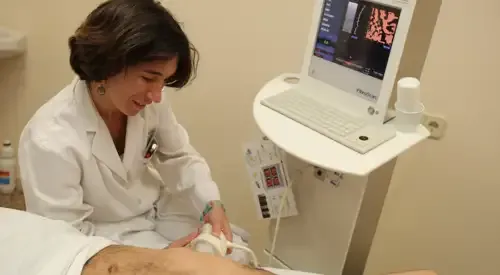
Fatty liver is often suspected after a blood test shows abnormal transaminase levels or an ultrasound is performed.
To confirm excess fat, a liver elastography may be performed. This simple test can estimate the amount of fat and assess whether there is fibrosis in the liver.
A liver biopsy is sometimes needed to diagnose steatohepatitis or determine its severity.
How is fatty liver treated?
Fatty liver can improve and even be reversed if the underlying causes are addressed, especially in the early stages.
The most effective measures are weight loss, physical activity, a healthy diet, and proper control of diabetes and lipid levels.
For patients with advanced fibrosis, medications are available to help slow its progression, and many new compounds are being studied in clinical trials.
At the Hepatology Unit, we are confident that the outlook for this disease will change.
The Hepatology Unit
of the Clínica Universidad de Navarra
We are pioneers in the application of gene therapy in the treatment of liver tumors and hereditary metabolic diseases, and we have extensive experience in the diagnosis and treatment of viral hepatitis and in the treatment of liver cancer using radioembolization systems with ytrium-90 microspheres.
The Clinic is at the forefront in Spain in performing liver transplantation between living people.
Conditions we treat
Treatments we perform
- Hepatic Arterial Embolization
- Partial splenic embolization
- Genetic study in hepatology
- Liver Radiofrequency
- Liver Radioembolization
- Liver resection
- Liver transplantation

Why at the Clinica?
- Highly specialized team of professionals with more than 25 years of experience.
- Nursing team specialized in hepatic patients.
- Important research activity on the molecular mechanisms that cause some of these diseases.
Our team of professionals


