
DETECT THE RISK,
ACT IN TIME
Cardiovascular check-up
ICAP
A new approach to cardiovascular risk
The only check-up that incorporates the most advanced diagnostic technology to accurately measure your risk of stroke and heart attack.
The ICAP Cardiovascular Check-up at Clínica Universidad de Navarra is the first comprehensive cardiovascular risk assessment program designed to accurately measure the risk of suffering a myocardial infarction (heart attack) or a cerebrovascular accident (stroke).
It is intended for asymptomatic patients between 45 and 75 years old who have at least one risk factor and/or a direct family history of cardiovascular disease.
Our goal is to detect subclinical atherosclerosis before symptoms appear, to stratify each patient’s individual risk, and to offer personalized prevention strategies for myocardial infarction and stroke.
We combine the latest imaging technology, personalized clinical information, and the scientific rigor of an internationally renowned hospital, with minimally invasive tests performed in less than 48 hours for maximum comfort.
Contact us if you need more information or advice on the checkup you need.

The first comprehensive Cardiovascular Risk Assessment Program
Intended for asymptomatic patients aged 45 to 75 with at least one risk factor and/or a direct family history of cardiovascular disease.

Individual stratification
We stratify cardiovascular risk on an individualized basis for each patient.

Early
detection
We detect atherosclerosis before symptoms appear to recommend early revascularization procedures.

Personalized prevention
We offer prevention strategies for heart attack and stroke.
Learn more about Cardiovascular Screening
In only 48 hours, the medical team is able to have accurate information about the patient's cardiovascular status.
What is the process like?
1. Initial consultation
During this first consultation, Internal Medicine and Cardiology specialists perform a comprehensive blood workup, an electrocardiogram, and a detailed physical examination. In addition, if necessary, the evaluation may include specialists in Endocrinology, Nephrology, Vascular Surgery, and/or Neurology.
2. Precision diagnosis
Next, advanced imaging tests are carried out to provide a precise view of the condition of the coronary arteries and the vascular system as a whole. These include coronary computed tomography angiography (CTA), coronary artery calcium (CAC) scoring, extracardiac CT angiography, and analysis using FFR software, which assesses the functional impact of possible arterial lesions.
3. Advanced risk analysis
The evaluation is completed with a personalized risk profile that incorporates advanced genetic and biochemical tools: polygenic and monogenic genetics to identify hereditary predispositions, as well as measurement of lipoprotein(a) and other residual risk biomarkers that allow for a more refined overall assessment of cardiovascular risk.
4. Individualized preventive plan
Based on all the clinical data obtained, a personalized preventive plan is developed, combining medical treatment and specific lifestyle recommendations with the aim of reducing the future risk of cardiovascular disease.
5. Ongoing follow-up
The program includes two follow-up visits: at 3 or 6 months, consisting of a consultation and blood work, and at 18 months, consisting of a consultation, blood work, and a coronary CTA.
Who is the target audience?
The ICAP Checkup is intended for asymptomatic patients between 45 and 75 years of age, especially those with a direct family history of cardiovascular disease or any identified cardiovascular risk factor, such as:
- Diabetes
- High blood pressure
- Obesity
- High cholesterol
- Smoking
- Stress
Our program offers you a comprehensive and personalized evaluation of your cardiovascular health with the goal of minimizing the likelihood of complications. To assess and, if necessary, treat your cardiovascular risk, Clínica Universidad de Navarra relies on two key factors:
- State-of-the-art diagnostic techniques.
- A specialized multidisciplinary team.
State-of-the-art diagnostic technology to assess subclinical atherosclerosis
We combine the latest imaging technology, personalized clinical information, and minimally invasive tests performed in less than 48 hours for your maximum convenience, in order to assess atherosclerosis before it causes symptoms.
Coronary CT angiography: An advanced, noninvasive imaging technique that makes it possible to visualize the coronary arteries, assess the actual degree of narrowing (stenosis), and detect possible atherosclerotic plaques.
Extracardiac CT angiography: Provides a comprehensive evaluation of the main arterial tree (carotid arteries, aorta, iliac arteries, and femoral arteries) to detect lesions outside the coronary territory and obtain an overall vascular map.
Coronary plaque composition by imaging: Using advanced imaging techniques, the specific characteristics of each plaque are identified (stability, risk of rupture, lipid content), providing a more precise view of the risk of a cardiovascular event.
Fractional flow reserve: This analysis calculates the degree of reduction in blood flow in arteries with significant lesions. It makes it possible to predict the need for revascularization with a high degree of reliability.

Why have a check-up at the Clínica Universidad de Navarra
We are the best private hospital in Spain for the tenth consecutive year.
(Ranking Monitor de Reputación Sanitaria 2024)

Experience
and Leadership
More than 60,000 check-ups performed. A pioneering unit in Spain backed by a leading university hospital.

Multidisciplinary
Assessment
More than 40 specialties (Cardiology, Endocrinology, Neurology…) for rapid-access consultations.

No unnecessary
radiation
A protocol focused on non-invasive techniques, minimizing risks and prioritizing your well-being.

Speed
and Coordination
All tests completed in less than 48 hours, with a final report and action plan.
Our team of professionals
Pioneering program that uses the latest technology and the best human team to offer you a complete and personalized evaluation of your cardiovascular condition.
A total of 9 specialties integrated in the Vascular Medicine Area (Internal Medicine, Cardiology, Radiology, Nuclear Medicine, Endocrinology, Neurology, Nephrology, Vascular Surgery and Hematology) work together to determine the risk of suffering cardiovascular complications and establish the most appropriate treatment for each patient.


How much do you know about yourself?
At the Clínica we know that information is the best medicine.
Learn about the rest of the Clínica's check-up programs.
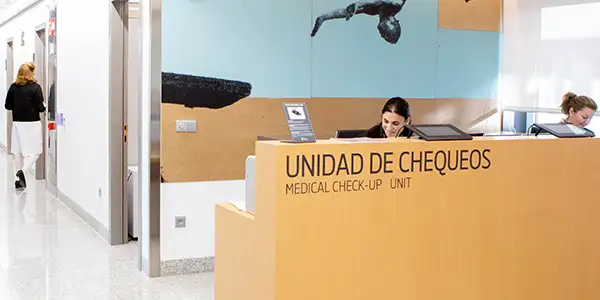
Medical checkup
Early diagnosis of diseases is the best method for a longer and healthier life. In 24 hours we perform a comprehensive examination to fully assess your state of health.

Genomic check
A leap in precision: from preventive to predictive medicine. La Clínica, leader in medical screening, launches the most accurate predictive medicine thanks to the combination of medical screening and genetic analysis.

Prevention programs
The earlier cancer is diagnosed, the greater the chances of a successful cure. Learn about our specific programs aimed at prevention and early detection.